
We don't sell hardware. We sell a monetization point for tourist traffic.
$3,500 per point. 320 Georgian hotels already signed. Returns paid from transaction cashflow.
- minimum entry — 50 points
- $175,000
- hotels signed
- 320
- investor share until principal is returned
- 80%
Problem
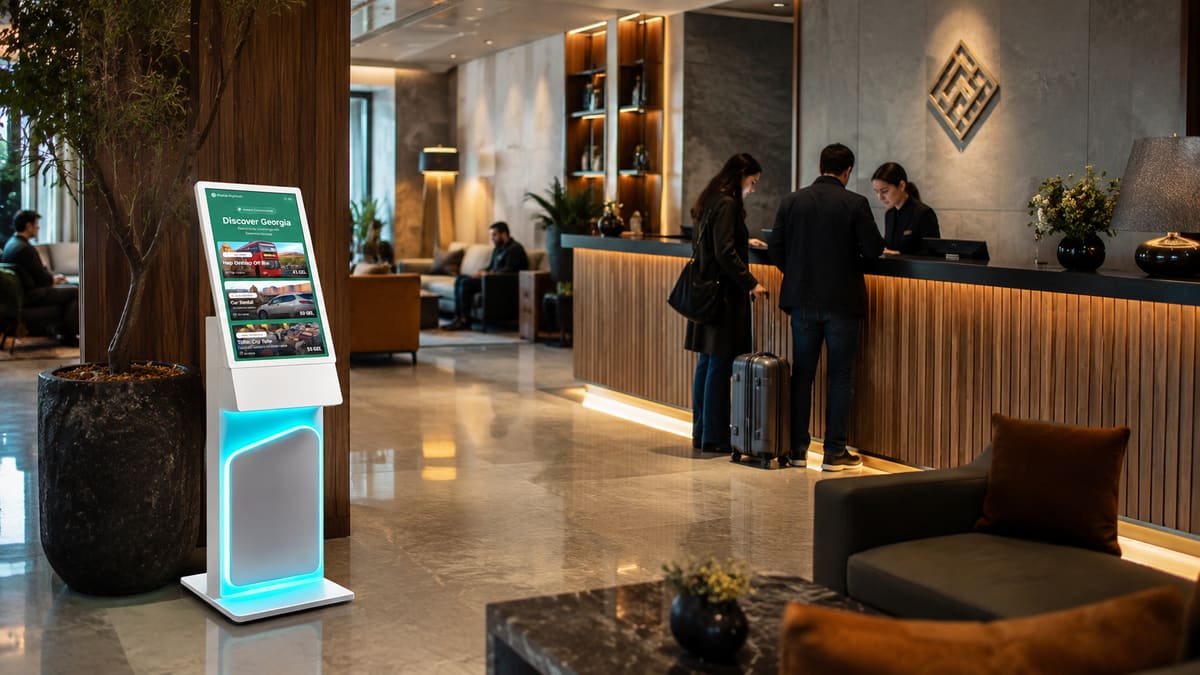
Money is sitting in the hotel lobby. Nobody is picking it up.
The tourist
- Four days in the country and a full wish list: a tour, a car, an airport transfer.
- No local language, no idea what a fair price is, and a real fear of being ripped off.
- Googling over roaming data and messaging ten chats means spending a vacation evening on logistics instead of rest.
The hotel
- Hears the same question at the front desk every day: "So what is there to do here?"
- The front desk is not a travel agency: no catalog, no provider contracts, no time to sell.
- That demand walks out the door to street middlemen — or never converts at all.
Between a tourist holding money and a provider holding services there is a gap. Nexia fills it.
Solution
A store where the tourist is standing
One guest, one purchase
Evening, a hotel in Batumi. A guest from Germany needs to be at the airport by six tomorrow.
- 1
1.Walks up to the Nexia terminal in the lobby, taps German.
- 2
2.Category "Transfers" → airport → tomorrow, 6:00.
- 3
3.Pays by card: $22, catalog price, no haggling.
- 4
4.The voucher and the driver's number arrive on their phone.
90 seconds from "how do I get out of here?" to a solved problem. The front desk never looked up. The provider got the order instantly.
The service contract is formed directly between the guest and the provider. Nexia is a marketplace operator and earns a commission.
The investor product
What a monetization point is
One monetization point = $3,500 for the investor.
What the price includes
- A large 32″ terminal
- An 11″ tablet unit at the front desk
- Marketplace development and support
- Hardware connection to the Nexia system and bank integration
- Continuous onboarding of new service providers
- Advertising contract sales
A monetization point ≠ one terminal
A point is the cashflow of one hotel, not a unit of hardware. The hotel's traffic decides how many screens go in. The investor's price does not change.
Small hotel
1 tablet 11″
$3,500
the investor's price per point — in every case
Mid-size hotel
1 terminal 32″ + a front-desk tablet
$3,500
the investor's price per point — in every case
Large hotel
4 terminals 32″ + 8 tablets 11″
$3,500
the investor's price per point — in every case
The deployment model includes 320 large and at least 320 small devices, plus a booking-link integration into hotel reservation flows.
Why now
Why now
Georgian tourism is at an all-time high
Lobby traffic is daily and growing. Tourists carry more spending money than ways to spend it on site.
Hotels already said yes
320 hotels signed distribution agreements before the round. Demand for the channel is proven by contracts — it is not a hypothesis.
Lobby space is finite
Each front desk has room for one screen. Whoever takes it first owns the channel: there is no second slot.
Hardware got cheap
Screens, tablets and card payments are now familiar and inexpensive. A point pays for itself even with low traffic.
Market
Counting from money, not headcount
One guest often pays for the whole family, so we don't count heads — we count the market's money: what tourists spend in Georgia, and what share of that volume the network needs.
$4.4B
spent by international tourists in Georgia per year
National Bank of Georgia, 2024
0.192%
of that volume is all the network needs to capture
$8.45M
annual GMV of a 320-point network
The realistic scenario: 100 transactions per point per month at a $22 average check. Network gross profit: $2.07M a year. The model runs on a fifth of a percent of the market; the full scenario math is below.
Traction
Done before the round
The platform is built
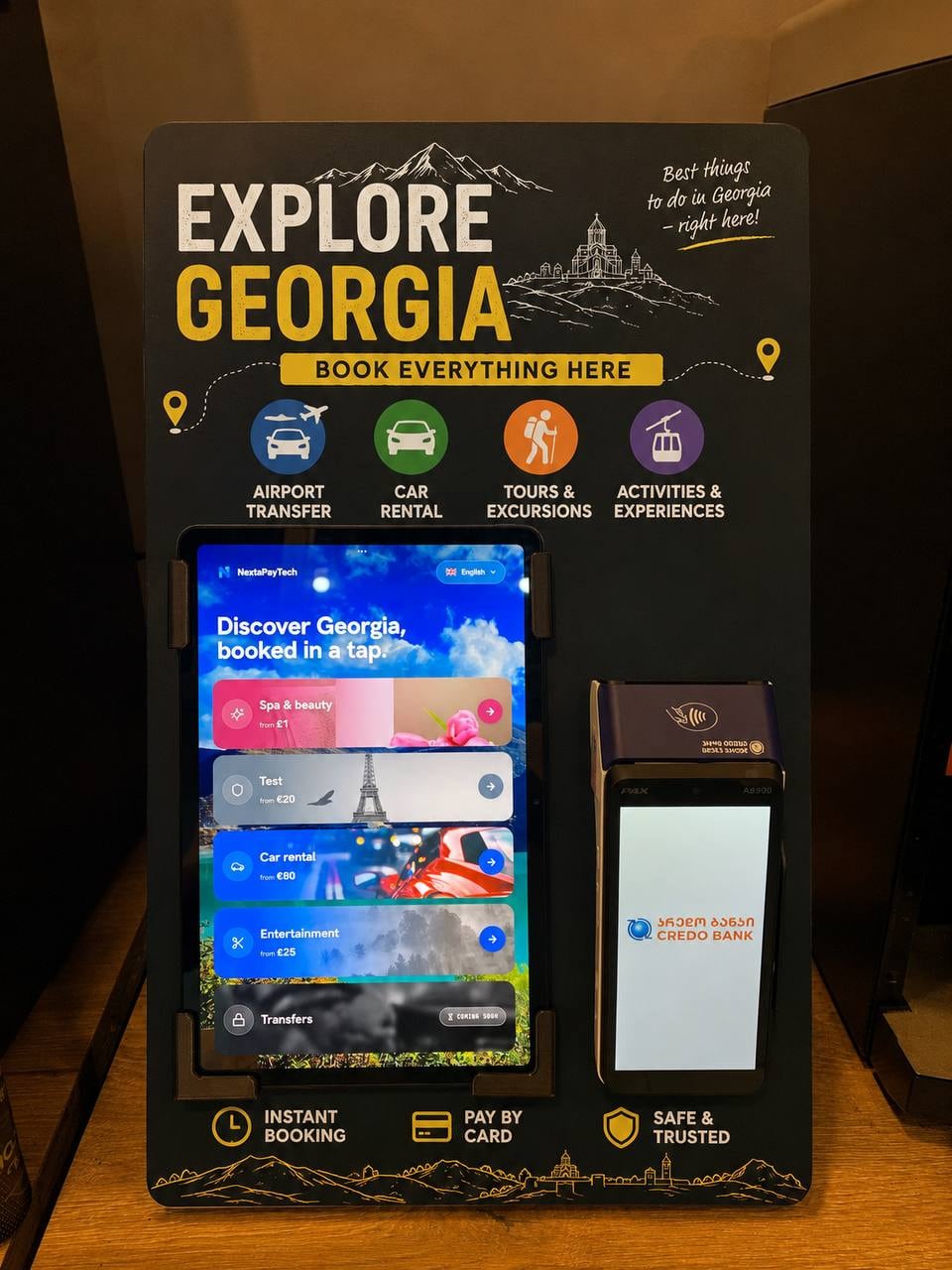
Web marketplace, provider portal, admin panel, hotel-facing interface. Shown live.
320 hotels — signed distribution
Signed distribution agreements with Georgian hotels. Access to ~1,800 hotels through industry channels.
Bank integration completed
The contract with Credo Bank is signed and the integration is finished: card payment at the point works.
Providers under contract
Contracts signed, services in the catalog: GoTrip, Localrent, Tripbox, Samraan Spa, Kaasland, Gino. Rafting and Tusheti helicopter tours were onboarded through our CRM and are available online exclusively with us.
A written tax authority ruling
Confirms that VAT applies only to Nexia's commission.
Pilot unit assembled
The small unit is assembled and is being tested by the team — we are debugging guest flows and operations ourselves before tourists touch it.
Every item is backed by a document or a live system in the data room.
Unit economics
Unit economics under a microscope
This is not an investment scenario. This is a stress test: what happens when every variable equals one — one terminal, one hotel, one provider, one customer buying once a day, 20 days out of 30.
One transaction
Customer check
+$22.00
Provider payout
−$15.00
Nexia commission
31.8% of the check
+$7.00
Acquiring fee, 2.5% of the full amount
−$0.55
VAT 18% — on the commission only, included in it ($7 × 18/118)
−$1.07
Gross profit — the revenue-share base
$5.38
VAT applies only to Nexia's commission ($7), not to the full transaction amount ($22): Nexia operates as a disclosed agent, and the provider's money is not Nexia's turnover. This is a structural margin advantage, not an assumption.
One point in the minimal case
- transactions per month
- 20
- gross profit per month
- $107.6
- gross profit per year
- $1,292
Everything set to one: one terminal, one hotel, one provider, one purchase a day. That is an unrealistically low floor — and the point is still profitable. Everything above is upside.
Investment scenarios start at 60 transactions per month.
To the scenariosScale
Three scenarios
Average check and margin stay the same in every scenario. Only two variables change: transactions per point per month, and the number of points.
Points in the network
Scenario
Single-point economics
| Scenario | Tx/mo | Gross profit/mo | Gross profit/yr | Principal return, $3,500 | Investor cash over the horizon | MOIC |
|---|---|---|---|---|---|---|
| Pessimistic | 60 | $322.9 | $3,875 | 17.5 moincl. the 4-month holiday | $5,825 | 1.66× |
| Realistic | 100 | $538.2 | $6,459 | 12.1 moincl. the 4-month holiday | $7,375 | 2.11× |
| Optimistic | 140 | $753.5 | $9,042 | 9.8 moincl. the 4-month holiday | $8,925 | 2.55× |
Horizon = 4-month holiday + principal return phase + 36 months at 20%.
Network gross profit per year
| Points | Providers | Investor CAPEX | Gross profit/yrRealistic |
|---|---|---|---|
| 50 | 5–7 | $175,000 | $322,932 |
| 150 | 15 | $525,000 | $968,797 |
| 320 | 25+ | $1,120,000 | $2,066,766 |
| 500 | 30+ | $1,750,000 | $3,229,322 |
$1.24M
$2.07M
$2.89M
Pessimistic
Realistic
Optimistic
320 points × 100 tx/mo
What is NOT in these numbers
excluded from the math abovePre-arrival channel
Selling services via a link before landing — across the hotel network, ~100 services in the catalog.
QR network
QR codes distributed across the same hotels, beyond the terminals.
Advertising monetization
The economics of ad contracts on the network's screens.
Booking integrations
Capturing demand inside digital reservation environments.
The model pays back without them. They are pure upside.
Return structure
How the money comes back
Months 1–4
Investment holiday
No payouts: installation, integrations, provider onboarding, traffic ramp-up.
Until $3,500 is returned
Principal return phase
Revenue share of 80 / 20 in the investor's favor, applied to gross profit (i.e., after acquiring fees and VAT), until the full $3,500 is returned.
investor 80%company 20%
36 months
Yield phase
After the principal is returned, revenue share 20 / 80 in the company's favor.
investor 20%company 80%
After 3 years
The fork
Terms depend on whether the investor has fully funded the Georgia rollout.
What comes after 3 years
The investor has fully funded the Georgia rollout
The investor picks one of two options:
- Revenue share on a permanent basis, with the percentage renegotiated
or
Equity participation: a stake at company valuation, with the amount already invested credited as a discount
Included with either option:
- An exclusive offer to enter other countries
- Access to the advertising channel of a 320+ hotel network — and, later, of other countries
The rollout is not fully funded
The investor retains the full 3-year yield phase on the 20 / 80 scheme.
Durability
Why this is hard to copy
The hard groundwork is done
320 hotels with signed distribution, access to ~1,800 Georgian hotels through industry channels. The platform is built: web, provider portal, admin, hotel-facing. Bank integration completed, providers under contract.
Margin protected by structure, not price
VAT on the commission only: Nexia is a disclosed agent, and the provider's money is not its turnover. The position is confirmed by a written ruling of the Georgian tax authority. Undercutting on price cannot replicate this advantage.
We stand where the decision is made
Online platforms are optimized for pre-trip planning. Payment systems serve a decision already made. Nexia creates the transaction where the tourist physically stands — in the lobby, at the "what's next?" moment.
Physical distribution is finite
Space at the front desk is a scarce resource: each hotel has one. Whoever takes it first owns the channel.
Team
Team
Founder / CEO
20+ years in tourism. Operated a network of 86 terminals selling tourist services in Spain: ~150 transactions per terminal per month — 1.5× our realistic scenario.
Co-founder / CTO
Built and runs a 50+ unit self-service network on proprietary technology, with payment integrations and real processing volume. Has launched two self-service projects in Georgia with bank integrations.
Engineering
Senior engineers: IoT interfaces, distributed backend, payment integrations, high-throughput architecture.
Legal
20+ years of structuring investment transactions.
Company economics
The questions an investor will ask
The team is small, and provider onboarding, support, content and reconciliation are automated with AI. Fixed costs do not grow in proportion to the number of points.
The 80 / 20 phase is temporary and is tracked per point. During the investment holiday there are no payouts at all, and after the principal is returned the company's share becomes 80%.
With staged deployment, points reach payback in waves, so the company's weighted share of network gross profit starts climbing within the first months.
Company share of network gross profit
month / company share
Deployment of 320 points in waves over 12 months, realistic scenario (100 tx/mo). Holiday: no payouts; principal return phase: 20% to the company; after return: 80%.
The investor buys into the network's cashflow, not a single location. Flows are aggregated across the portfolio of points: a strong location covers a weak one, and the point itself can be moved to another hotel.
No. Payouts are tied to actual transaction flow. This page shows a model and scenarios, not a promise of returns.
Nexia is a disclosed commercial agent: the provider's money is not the company's turnover, and the tax applies to the commission. The position is confirmed by a written ruling of the Georgian tax authority.
The investor signs an investment agreement that fixes every term: the price per point, the revenue share by phase, the payout procedure and reporting.
The equipment belongs to Nexia — that is what lets us service, upgrade and move points between hotels. At the investor's request, a pledge of the equipment in their favor can be considered.
A memorandum is signed alongside the agreement: it secures the investor's option to fully fund Georgia and, after the 3-year yield phase (20% to the investor), receive all the benefits of the fork.
The round
We are raising $1,120,000 to deploy 320 monetization points across Georgia. Minimum entry — 50 points, $175,000; further funding comes in tranches of 50 points.
Price per point — $3,500. Installation pace — 1–2 terminals a day, so a 50-point tranche deploys within one to two months.
What gets done in 12–18 months
- 320 monetization points deployed in Georgian hotels
- 25+ service providers connected to the marketplace
- GMV and network transaction statistics in regular investor reporting
- Georgia's transaction base packaged as the case for entering a second country
Discuss participation
Leave your contact details — we will send the round terms and data-room access.